Sunday, May 2, 2010

SPARK: The Revolutionary New Science of Exercise and The Brain


This book launches with an amazing case study (Naperville Central High School near Chicago) where key players have significantly improved learning through systematic and strategic exercise that was appropriate for the learner. My first question is why are PE, recess and other physical exercise being reduced or dropped in so many schools? Why aren’t more schools looking at innovative ways to implement this approach or one based on the same principles?

Surprisingly, this book isn’t simply about learning in schools, but learning in general and the key exercise can play. The author, John Ratey, MD, who also wrote Driven to Distraction, explores how exercise can help everyone with learning (plus optimal emotional and physical health) by diminishing stress, anxiety, depression, attention deficit, addiction, hormonal changes, and impacts of aging. Of course, this isn’t the first book on the importance of exercise in all these areas, but the power of this book is the constant reference to brain research. Prior to the past five to ten years, there were strong correlations between exercise and diminished effects of stress, anxiety, etc. But we now have solid evidence that proves exactly how much exercise, to what level of intensity, and in which situations. Ratey is a clinical associate professor of psychiatry at Harvard Medical School, but also runs his own private practice. Therefore, not only does Ratey reference recent, remarkable research, but he embeds it in a human context.

Given the story of how a “fitness program helped one U.S. school district out of 19,000 rank first in the TIMMS science test, and given brain research evidence that s incontrovertible: “aerobic exercise physically transforms our brains for peak performance,” will we take the steps to give students this added benefit? Also. will we make it feasible and attractive for teachers to exercise as well?

http://www.flickr.com/photos/rosswebsdale/2442167618/

Learning from the Extremes

This White Paper, published by Cisco, is a report that outlines four basic strategies governments (and motivated individuals and groups) in the developing and developed world can pursue to meet learning challenges: improve, reinvent, supplement, and transform schools and learning.

Here is the visual that so perfectly captures their framework:


However, Cisco doesn’t just stop there, they analyze specific examples in both the developed and developing world. Not only is this paper a fascinating read, but more importantly, it gives hope of possibilities for truly transformative innovations in the area of learning.

I believe International Schools do fairly well in “improving schools (through better facilities, teachers, and leadership”) and “supplementing schools by working with families and communities.” (Of course given the clientele and resources, this is not a great challenge.) However, these same “highly successful schools” seem completely paralyzed in moving forward with reinventing their schools to better meet the learning needs and desires of today and tomorrow. At least in that arena, there are rumblings if not action. In the final quadrant, “transforming learning by making it available in radically new ways” is not on the radar screen. Imagine if we were able to re-conceptualize the concept of the “virtual school” for our kids so that it wasn’t viewed as just an extra load of homework, but explore “radical new ways” for students to learn.

As the conclusion of the paper states, “The 20th century was the century of the teacher and the school, the class and the exam. The 21st needs to become the century of the educational entrepreneur and of the pupil as protagonist, self-motivated and self-organized learning, at scale, wherever and whenever it is needed.”

When and where will international schools work towards disruptive innovation in learning to meet the needs of our students? Will you and I become the needed social entrepreneurs in this area or are we too main-stream and embedded?


http://www.dailygalaxy.com/photos/uncategorized/shutterstock_2403515.jpg

DRIVE: The Surprising Truth About What Motivates Us


For those who loved A Whole New Mind by Daniel Pink, you will definitely want to get your hands on DRIVE. Or if you enjoyed Alfie Kohn’s Punished By Rewards back in the 1990’s, you’ll love this! I’m only a couple of chapters into it and already highly recommend it. Here are Pink’s Twitter and cocktail summaries:

"TWITTER: Carrots & sticks are so last century. Drive says for 21st century work, we need to upgrade to autonomy, mastery & purpose.

COCKTAIL PARTY: When it comes to motivation, there’s a gap between what science knows and what business does. Our current business operating system—which is built around external, carrot-and-stick motivators—doesn’t work and often does harm. We need an upgrade. And the science shows the way. This new approach has three essential elements: (1) Autonomy—the desire to direct our own lives; (2) Mastery—the urge to get better and better at something that matters; and (3) Purpose—the yearning to do what we do in the service of something larger than ourselves."

Like, Kohn, Pink debunks the motivation myths grounded in behaviorialism that we still find prevalent not only in business, but throughout the world of education. There are places that have shifted to more of a “pull” approach” rather than a push, but these are few and far between. So, the question is . . . how long until this becomes the way we facilitate learning? What’s holding us back? How can we capitalize on the powerful pockets already there?

http://www.flickr.com/photos/peterjon/344323226/

What's the Big Idea: Teaching and Learning for Transfer

http://www.flickr.com/photos/mrpixure/3203850255/

“We teach it because they said we had to” is one of my professional pet peeves. It is my stance that, as professionals, unless we have clarity about the WHY of our learning goals, we should not be spending any time on them.

Many people know about Understanding by Design and/or Teaching for Understanding of Project Zero. Neither of these is a “program” or “template” but rather a paradigm for thinking and planning for learning that is focused on key principles of learning. Two key learning principles speak directly to this issue of being clear about the WHY of your learning goals:
1. Learning is purposeful and contextual. Therefore, students should be helped to see the purpose in what they are asked to learn. Learning should be framed by relevant questions, meaningful challenges, and authentic applications.
2. Experts organize or chunk their knowledge around transferable core concepts (“big ideas”) that guide their thinking about the domain and help them integrate new knowledge. Therefore, content instruction should be framed in terms of core ideas and transferrable processes, not as discrete facts and skills.
Copyright 2010 Jay McTighe and Grant Wiggins

Ultimately if we’re not clear about the purpose or relevancy of our learning goals, we obviously can’t contextualize the learning for students. Also, if we are the facilitators responsible to guide students’ building of understanding, isn’t it therefore our responsibility to frame this learning around the key understandings (with related skills and knowledge) and clearly communicate the relevance of this learning?

Or better yet, might we be framing the big ideas, skills, and knowledge based on students’ questions and desires to explore?

Saturday, February 27, 2010

Sustainability, Final Project Planning

Taking Action by creating a Public Service Announcement

As stated in the previous blog, the Grade 5 at ISB took some risks this year by attempting an integrated (social studies, language arts, and science) unit on Sustainability. Not only does this meet our school's mission of developing Global Citizens, but it also incorporates a fair amount of the TAIL standards:
  • Recognize bias in digital resources while researching an environmental issue with guidance from the teacher. (TAILs: 1, 2)
  • Explore causes, consequences, and possible solutions to persistent, contemporary, and emerging global issues, such as pollution and endangered species. (I.f)
  • Recognize and interpret how the "common good" can be strengthened through various forms of citizen action (A.j)
  • Identify, collaborate, and investigate a global issue and generate possible solutions using digital tools and resources. (TAILs: 1, 2, 4, 5)
We framed this final "take action" phase of the unit with this essential question: As global citizens, how can we contribute to a sustainable future?

Through this third phase of the unit, we were hoping that students would develop the understanding that Global Citizens . . .
  • understand that sustainability is meeting the needs of the present without compromising the ability of future generations to meet their needs.
  • keep informed about current sustainability issues
  • examine sustainability issues, in depth, in which they’re interested
  • learn how to deal with sustainability issues, which do or can affect them
  • consider probable and preferable futures and human potential to affect change
  • plan and take action towards a sustainable future
We then developed the following GRASPS Task:
Goal: Help your family reduce its ecological imprint. (We've been exploring the concept of an environmental footprint and uncovering the reality that currently humans consume more resources than the earth can replensh and therefore we are not functioning in a sustainable manner. Students engaged in an online "footprint" analysis and then came up with ways they were willing and able to diminish their footprint)
Role: You are a global citizen concerned about the impact your family is having on the sustainability of the environment.
Audience: Your family and any other interested global citizens around the world
Situation: You need to analyze one aspect of your family’s environmental footprint, research why there is such an impact and propose innovative ways to diminish that impact in order to create a preferable future.
Product, Performance, Purpose: * You will make a compelling Public Service Announcement to include the following:
1st min (max) = communicate what the problem is
2nd min (max) = communicate why this is a problem and its impact on the sustainability of the planet?
3rd min (max) = what are we going to do about it, solution to the problem

http://treadlightly.tigweb.org/challenge.html

Thanks to our to our Tech leader, Chrissy, here is our proposed tentative timeline:

1 session: Explore iMovie (Great idea from Jeff Utecht)
1 session: Introduce and analyze PSA using “Digital Bridges”
1-2 sessions: immersion in PSAs and analysis of several (Problem, cause/effect, solution + use of audio, visual, and text in delivering the message)
2-4 sessions to Plan (brainstorm, research, + storyboard phase)
• Use a storyboard to plan out your PSA • Write a script based on the research • Find pictures, talk about research, citing sourcing, how to save and organize images Use: Compfight or Search:Creative Commons (both search flickr) • Find creative commons music for the video (no copyright probs) Use: http://jamendo.com
2 sessions: Create the PSA
1 sessionL Peer Review
1 session: Reflect

Evidence of Learning:
  • Rubric: (generic digital storytelling rubric currently being tailored to suit this project, which includes the content pieces)
  • Class Reflection: what could have been improved and to what degree we might be impacting future environmental sustainability
  • Self-Assessment Rubric (generic digital storytelling self-assessment rubric currently being tailored to suit this project)
  • Sharing: Students upload their PSA to their blog
  • Individual reflection: write blog post reflecting on their personal experience with the project
The next four blogs will be reflections on the various stages of turning this plan into reality.

Friday, December 11, 2009

Plan for Sem II Project

I have the great fortune of working with the Grade 5 team in creating an interdisciplinary unit, Sustainability, that weaves together outcomes of Science, Social Studies, Language Arts, and TAIL. We've outlined just the Global/Digital citizen piece of the project here.

Stay tuned as we update how this project progresses over the next three months.

Wednesday, December 9, 2009

NETs for Teachers


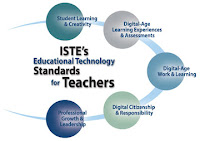
Continuing from the previous blog, let's look more closely at the NETs for Teachers:

1. Facilitate and Inspire Student Learning and Creativity. Teachers use their knowledge of subject matter, teaching and learning, and technology to facilitate experiences that advance student learning, creativity, and innovation in both face-to-face and virtual environments. Teachers:
a. promote, support, and model creative and innovative thinking and inventiveness
b. engage students in exploring real-world issues and solving authentic problems using digital tools and resources
c. promote student reflection using collaborative tools to reveal and clarify students’ conceptual understanding and thinking, planning, and creative processes
d. model collaborative knowledge construction by engaging in learning with students, colleagues, and others in face-to-face and virtual environments
  • To me, this is all linked to one's philosophy. Do you value developing innovative thinking in children? Do you believe in real-world application and problem solving? Do you believe that children construct their understanding and that revealing misconceptions and level of understanding is all part of the process in learning? To make this a reality, our learning leaders need to buy in to this philosophical stance.

2. Design and Develop Digital-Age Learning Experiences and Assessments
Teachers design, develop, and evaluate authentic learning experiences and assessments incorporating contemporary tools and resources to maximize content learning in context and to develop the knowledge, skills, and attitudes identified in the NETS•S.
Teachers:
a. design or adapt relevant learning experiences that incorporate digital tools and resources to promote student learning and creativity
b. develop technology-enriched learning environments that enable all students to pursue their individual curiosities and become active participants in setting their own educational goals, managing their own learning, and assessing their own progress
c. customize and personalize learning activities to address students’ diverse learning styles, working strategies, and abilities using digital tools and resources
d. provide students with multiple and varied formative and summative assessments aligned with content and technology standards and use resulting data to inform learning and teaching

  • Again, this is the general work of learning facilitators--designing learning experiences and assessments, using the best available and most engaging tools that meet given learners' needs (only figured out through authentic on-going assessment). Once again we see philosophical tenets such as valuing diverse learning styles and allowing students to personalize and show their learning in varied formats. What if teachers don't philosophically believe in this?

3. Model Digital-Age Work and Learning
Teachers exhibit knowledge, skills, and work processes representative of an innovative professional in a global and digital society.
  • Couldn't one exhibit these skills and knowledge and yet not necessarily improve student learning? Obviously one needs this content base but this standard doesn't seem learning-centered.
Teachers:
a. demonstrate fluency in technology systems and the transfer of current knowledge to new technologies and situations
b. collaborate with students, peers, parents, and community members using digital tools and resources to support student success and innovation
c. communicate relevant information and ideas effectively to students, parents, and peers using a variety of digital-age media and formats
d. model and facilitate effective use of current and emerging digital tools to locate, analyze, evaluate, and use information resources to support research and learning

  • So basically we need teachers to be life-long and effective collaborators, communicators, and learners? Doesn't that encompass all of this?

4. Promote and Model Digital Citizenship and Responsibility
Teachers understand local and global societal issues and responsibilities in an evolving digital culture and exhibit legal and ethical behavior in their professional practices.
Teachers:
a. advocate, model, and teach safe, legal, and ethical use of digital information and technology, including respect for copyright,intellectual property, and the appropriate documentation of sources
b. address the diverse needs of all learners by using learner-centered strategies and providing equitable access to appropriate digital tools and resources
c. promote and model digital etiquette and responsible social interactions related to the use of technology and information
d. develop and model cultural understanding and global awareness by engaging with colleagues and students of other cultures using digital-age communication and collaboration tools

  • Much like what we saw with the NETs for Administrators, of course we need to model, promote and facilitate ethical and responsible use of digital resources--any resources for that matter.

5. Engage in Professional Growth and Leadership
Teachers continuously improve their professional practice, model lifelong learning, and exhibit leadership in their school and professional community by promoting and demonstrating the effective use of digital tools and resources.
Teachers:
a. participate in local and global learning communities to explore creative applications of technology to improve student learning
b. exhibit leadership by demonstrating a vision of technology infusion, participating in shared decision making and community building, and developing the leadership and technology skills of others
c. evaluate and reflect on current research and professional practice on a regular basis to make effective use of existing and emerging digital tools and resources in support of student learning
d. contribute to the effectiveness, vitality, and self-renewal of the teaching profession and of their school and community

  • I like the part about being a life-long learner and global citizen as a model for students. However, many of the other details have more to do with teachers' lives outside of the learning realm and won't necessarily translate into improved student learning.
http://diskurs.hum.aau.dk/english/dexus3/images/collaboration.jpg

In conclusion, I feel these standards are not necessary. I believe we need to have philosophical agreements and support teachers in gaining the knowledge, skills, and understandings to become life-long learners, collaborators, and communicators. The facilitation for learners will then happen naturally. What do you think?

NETs for Administrators

http://www.flickr.com/photos/edborhan/3470278490/


Given I don't have a classroom for which I manage tools and peripherals, I've decided to focus the final two blogs on the NETs standards for Administrators and Teachers. I'm currently neither an administrator nor a teacher, so I'm wondering which of these two most apply to my role? In order to reflect further I would like to take a look at the descriptors and question or comment on each one in relation to ISB or to learning institutions in general.


1. Visionary Leadership. Educational Administrators inspire and lead development and implementation of a shared vision for comprehensive integration of technology to promote excellence and support transformation throughout the organization.
  • What is our shared vision? Like other curricular areas, do we have a philosophy that one and all are aware of and that is driving everything we do in this area?
  • What do we mean by comprehensive and how are we measuring this? Do we have similar expectations for all areas or are there greater expectations for certain areas? If so, why? If not, does the reality reflect this?
Educational Administrators:
a. inspire and facilitate among all stakeholders a shared vision of purposeful change that maximizes use of digital-age resources to meet and exceed learning goals, support effective instructional practice, and maximize performance of district and school leaders
  • How do you measure inspiration? According to research, "inspirational" leaders are not necessarily the most effective in improving learning.
  • What are the most effect use of digital-age resources--has this been researched? If so, what are the results?
b. engage in an ongoing process to develop, implement, and communicate technology-infused strategic plans aligned with a shared vision
  • So, does this mean using technology to help reach ISB's vision? If so, is this the responsibility of all administrators or of those responsible for IT?
c. advocate on local, state, and national levels for policies, programs, and funding to support implementation of a technology-infused vision and strategic plan
  • not really applicable to our situation
2. Digital-Age Learning Culture. Educational Administrators create, promote, and sustain a dynamic, digital-age learning culture that provides a rigorous, relevant, and engaging education for all students.
  • I love the end of this statement, "rigorous, relevant, and engaging education for all students." However, what exactly does a "digital-age learning culture" look and feel like?
Educational Administrators:
a. ensure instructional innovation focused on continuous improvement of digital-age learning
  • First of all, does our culture value and promote innovation? Why or why not and what is our evidence?
b. model and promote the frequent and effective use of technology for learning
  • This is pretty straightforward and seems doable for one and all!!
c. provide learner-centered environments equipped with technology and learning resources to meet the individual, diverse needs of all learners
  • Isn't technology simply another type of learning resource?
d. ensure effective practice in the study of technology and its infusion across the curriculum
  • This looks like a justification to have the TAIL standards embedded in the curricular area benchmarks.
e. promote and participate in local, national, and global learning communities that stimulate innovation, creativity, and digital-age collaboration
  • This is more modeling but not necessarily directly linked to student learning.

3. Excellence in Professional Practice. Educational Administrators promote an environment of professional learning and innovation that empowers educators to enhance student learning through the infusion of contemporary technologies and digital resources.
  • I believe that ISB does this one quite well, allocating a huge budget to resources and professional learning support.
Educational Administrators:
a. allocate time, resources, and access to ensure ongoing professional growth in technology fluency and integration
b. facilitate and participate in learning communities that stimulate, nurture, and support administrators, faculty, and staff in the study and use of technology
c. promote and model effective communication and collaboration among stakeholders using digital-age tools
d. stay abreast of educational research and emerging trends regarding effective use of technology and encourage evaluation of new technologies for their potential to improve student learning
  • Is this true just for technology or once again is technology a resource and we should always be looking for new resources that have the potential to improve student learning?

4. Systemic Improvement. Educational Administrators provide digital-age leadership and management to continuously improve the organization through the effective use of information and technology resources.
Educational Administrators:
a. lead purposeful change to maximize the achievement of learning goals through the appropriate use of technology and media-rich resources
  • I believe ultimately learning leaders are responsible for leading change that maximizes learning and technology and media-rich resources are possible resources with which to do this.
b. collaborate to establish metrics, collect and analyze data, interpret results, and share findings to improve staff performance and student learning
  • I agree with this, except for staff performance. If our goal is improved student learning our data collection should be focused on that. Teachers should have some liberty about how they get there.
c. recruit and retain highly competent personnel who use technology creatively and proficiently to advance academic and operational goals
d. establish and leverage strategic partnerships to support systemic improvement
e. establish and maintain a robust infrastructure for technology including integrated, interoperable technology systems to support management, operations, teaching, and learning
  • The three above are very specific to certain administrative roles and are currently being done here at ISB.

5. Digital Citizenship. Educational Administrators model and facilitate understanding of social, ethical, and legal issues and responsibilities related to an evolving digital culture.

Educational Administrators:
a. ensure equitable access to appropriate digital tools and resources to meet the needs of all learners
b. promote, model, and establish policies for safe, legal, and ethical use of digital information and technology
c. promote and model responsible social interactions related to the use of technology and information
d. model and facilitate the development of a shared cultural understanding and involvement in global issues through the use of contemporary communication and collaboration tools
  • I feel strongly that all learning leaders and facilitators should be responsible for this promotion and modeling of ethical behavior in the digital world.
In conclusion, looking at this NETs for administrator just further confirms my thinking that there is no need for separate standards for different learning leaders. Our focus should be on the knowledge, skills, and understandings we want to students to learn and then take responsibility for doing what it takes to promote, model, and facilitate such learning.

Monday, December 7, 2009

Flat World or Vertical diVisions?

How relevant are the NETs for Teachers and Administrators to being a "Good Educator" today?

Inevitably, we need all learning facilitators and learning leaders to be proficient and fluent in the skills of the area of learning that they are expected to facilitate for others. There are research findings in the content area of math, for example, that show that for student learning to happen the math teacher needs strong content knowledge, skills, and understanding. Therefore, we can assume that one needs to have the knowledge, skills, and understandings listed in the NETs in order to effectively guide learning in that area. Can we not assume this to be true for any type of learning?

http://www.yanswersblogth.com/b4/wp-content/uploads/2009/06/why.jpg

If we can agree on this premise, then I question WHY there are separate sets of NETs for Teachers and Administrators.

1. Facilitate and Inspire Student Learning and Creativity

2. Design and Develop Digital-Age Learning Experiences and Assessments

3. Model Digital-Age Work and Learning

4. Promote and Model Digital Citizenship and Responsibility

5. Engage in Professional Growth and Leadership

1. Visionary Leadership

2. Digital Age Learning Culture

3. Excellence in Professional Practice

4. Systemic Improvement

5. Digital Citizenship


I find it interesting that we're advocating that we need to prepare kids for a "flat," collaborative world, but we continue to structure and propel hierarchical organizational models. If we believe that kids can be experts and teach others (including teachers), then why are administrators the only ones responsible for establishing a digital age culture? Isn't a culture determined by the sum of all the parts? "Excellence in Professional Practice": wouldn't this be expected of both groups? Wouldn't "Designing and Modeling Digital Age Learning and Citizenship" ideally be done by all? More importantly, when will we focus more on the learning we hope to have happen than the way learning leaders and learning facilitators help make that learning a reality?

http://blog.darrylepollack.com/wp-content/uploads/2009/11/flatworld.jpg

When will we begin to walk the talk of this collaborative flat world?

Sunday, December 6, 2009

Assess, Analyze, and Act

How can teachers and schools ensure that their students are learning what they need when it comes to Technology and Information Literacy?

As with any learning, teachers need to know the trajectory so they can always support their students' learning progress with their "Zone of Proximal Development." As stated in the previous blog, the skills, knowledge, and understandings of the Technology and Information Literacy Standards need to be first and foremost strategically embedded throughout the curriculum rather than ad hoc add-ons that are often the reality of our status quo.

However, as with any benchmarks, these are approximate developmental sign posts along the learning journey. The teacher's job is to systematically assess where students are in relationship to these outcomes, and determine how they can facilitate the appropriate skills development that will move them forward. This seems simple and straightforward but with students at all levels in all areas, this is an incredibly complex challenge.

ASSESS

Imagine having an on-going e-portfolio that demonstrates what students have already done, know and understand. This would save the current teacher loads of assessing time and would move all educators towards looking at a "body of evidence" rather than an assessment or two. What tools exist already that might facilitate teachers collecting and collating such evidence?

http://www.coronadopacific.com/images/assess.jpg

ANALYZE

A body of evidence (e-portfolio coupled with teacher anecdotal notes) is only worth the effort if we take the time to analyze where children are on their learning journey and decide on next steps.
http://actingschmacting.files.wordpress.com/2009/04/analyze.gif

ACT

Our plans are only as good as the student learning that results from these efforts. All three steps of Assess-Analyze-Act are challenging but undoubtedly facilitating appropriate learning in the moment that best meets each student's needs still remains the "art" of our profession.


http://graphics8.nytimes.com/images/2008/04/20/magazine/20act-600.jpg

Friday, November 27, 2009

E3: Embedded Everywhere by Everyone


Whose job is it to teach the NETs and AASL standards to students?


This question is pretty simple for me, given that we’re currently functioning in a standards-based setting at ISB. I believe the related knowledge, skills and understandings of these standards should be embedded, everywhere, across all courses. Ideally, everyone, all teachers, would be involved. The AASL standards state that we’re developing students to . . .

1. Inquire, think critically, and gain knowledge.
2. Draw conclusions, make informed decisions, apply knowledge to new situations, and create new knowledge.
3. Share knowledge and participate ethically and productively as members of our democratic society.
4. Pursue personal and aesthetic growth.

Therefore, who could oppose embedding the learning targets of NETS/AASL where they naturally fit, working in concert the content-based learning outcomes already established in a given context?

However, my response is based on the following two assumptions:

Assumption #1: That these knowledge, skills, attitudes, and understandings are the underpinnings of "life-long learning literacies" and therefore should be embedded in all learning contexts. Ideally, it would be the way of “doing learning,” regardless of the curricular focus.

Assumption #2: That teachers actually philosophically agree with the underlying beliefs upon which these standards were built (i.e. wanting kids to think critically, create, be self-directed, etc.) Therefore, as with any set of standards, this one needs to be aligned with a school’s mission, vision, and definition of learning before the knowledge, skills, and understandings can be embedded and then actualized by teachers who believe in these foundational tenets.

Why not?


Ultimately, why can’t we have all learning standards embedded in authentic, interdisciplinary, relevant, collaborative and creative learning tasks? Why can’t students learn by doing and show their level of knowledge, skills, and understanding by what they are able to apply in coherent, engaging, and meaningful undertakings? Why can't we do away with the many walls and categories that break up the "whole" into seemingly endless "parts" (what David Perkins refers to as "elementitis" in his book, Making Learning Whole)? Doesn’t such an alternative approach have the potential to simultaneously reach the AASL vision above, the ISB vision, and the vision that we want all global citizens to become collaborative, self-directed, reflective, life-long learners? Just imagine . . .
  • We would no longer need grades--the learning evidence would be constantly evident and used to facilitate next steps.
  • We would automatically be meeting kids where they are and helping them learn in their zone of proximal development, maximizing learning time for everyone.
  • We would be engaging all learners and therefore democratizing participation in creating the future.
  • We would collaborate to solve real world problems in real time, accessing the knowledge as needed, developing the skills needed, and developing habits of mind that will last a lifetime.
This doesn't have to be a dream--it is already happening in many places around the world. (See examples in The Global Achievement Gap) Are we ready to be the risk-takers and inquirers necessary to make this a reality here and now?

Ultimately, why shouldn't we become life-long learning collaborators with our students to research and rehearse, prepare for and practice preferable futures?

Sunday, November 1, 2009

Final Project Reflection

It was nice to have the option between planning for or completing a product for our final project since I still have much to learn in terms of tools to make the plan of a "Literacy Central" (a central local for video tutorials and exemplars of key balanced literacy components) a reality (this will undoubtedly be a multi-year, multi-contributor project). Luckily, many of my colleagues, amazing literacy leaders, are already creating some of the pieces that could be plugged into it, such as those highlighted in each section below:

Teachers, IAs, substitutes: Video exemplars of the following with text and voice-overs explaining key points:
  • Reading workshop: We have a lot of footage of Maggie Moon, our visiting literacy coach modeling and coaching key components of the reading workshop. Vu Lam, a stellar 1st grade teacher has already edited footage of him leading an interactive reading session while coached by Maggie. Once I am more iMovie fluent, I will begin to edit and upload the footage we have of each component of the reading workshop at various grade levels
Administrators, Parents: Videos explaining the rationale and research base of using the balanced literacy framework and building an understanding of how readers and writers develop:
  • I count on being able to find many of these already created on YouTube or other sites rather than starting from scratch. This one may be a place to start (it is highly rated) but I suspect there are even better ones out there.


Students: Video exemplars of strategies for selecting and planning for reading, effective ways of tracking and sharing thinking with others, collecting and presenting evidence as to how they're progressing as a learner in the area of literacy, etc. Such videos would include:
  • Reading buddies: KG friends and excellent educators, Cindy and Susi, did a delightful video showing exactly what good reading buddies do and look like. Check it out here.
  • How to choose a just-right book: Our upper elementary group in this course created an unBEARably kid-friendly guide. Check it out here.
Now to mastering iMovie and screen casting to begin making this plan a reality.

Saturday, October 31, 2009

Screen Casts: School Scenarios

Screen casts have innumerable uses in our current learning landscape. I see three immediate needs that could be met more effectively using screen casts than what is currently done within the scope of our work with teachers, teams, IAs, students, and parents.

1. New Teacher Training
New teachers are overwhelmed with all of the nuts and bolts they have to learn when they first arrive. Imagine if there were a one-stop spot for them to access a tutorial for just-in-time learning as they need it rather than being inundated with information and paper when they first arrive. The following nuts and bolts screen casts are but a few of the many possibilities for this audience:
  • Taking attendance
  • Using the online calendars
  • Finding resources in the libraries (including the professional one)
  • Finding which books are available in the book room
  • How to request a substitute
  • How to access online resources for math, science, etc.

2. Demonstration Lessons
Teams could collaboratively develop demonstration lessons on using specific tools (i.e. measuring tools in science or math.) The purpose here is not to replace live classrooms but to have lessons available for students who were absent and/or need a repeat demonstration, training for new teachers, substitutes, IAs, and parent helpers.

3. Virtual School
Many schools around the world already have or are in the midst of preparing for continued learning in the case of an unforeseen school closing. In the international arena, these school closings have already happened a number of times in the past year. This isn't just an international school concern, however, especially with the H1N1 season raging across the northern hemisphere. Read about this school in Chicago:"Virtual Learning Is an Antidote to School Closure". If we are thoughtful and take time to prepare for the distant learning we want to have, the screen casts discussed in #2 (imagine how helpful some of those would become to parents of younger children) plus those that capture full demonstration lessons, read-alouds with commentaries, science experiments (since having all the equipment at home would be a near impossibility), 10 minute math . . . the list is endless. Suddenly "Snow Days" have taken on a whole new meaning (read Dana's thoughtful reflection on the disappearance of these days many of us so fondly remember.)


Food for Thought

The burning question that remains forefront in my mind is: Why haven't we Wiki-ized ourselves at ISB? Why don’t we collaboratively create an ISB center with tutorials for the many tools that teachers, IAs, adminstrators, students, and parents might access when they are needed for a learning endeavor. Many of these undoubtedly already exist. We now just need the orgainzational framework. Such a centralized approach would not only be using collaboration to work smarter, but would be a huge step in preparing for an effective virtual school in the eventuality of that being needed.

Liquid Learning Landscape

Change doesn't happen overnight but the shift that has begun in the learning landscape due to the availability of web-based video will only accelerate and deepen each day. I feel that the potential change for learning will be in three fundamental ways.

1. Democratization of Educational Resources

For me, this is the most exciting change that is happening and it will inevitably continue to expand. We are moving from money-making textbook companies to e-textbooks (that are not only text and images but have embedded videos), many of which are collaboratively written (i.e. Wikibooks), and continuously updated online to remain current and accurate. The impact on learning derives from the available information that is based on collective knowledge and understanding and it is not filtered for political reasons. More importantly, these resources will be affordable by anyone who has access to the web. (I'm convinced that the free e-books or almost free will quickly make the costly ones obsolete.) Lastly, imagine the environmental impact of no longer printing millions of textbooks that are costly and quickly outdated. We are still in the infant stages of this process with the attendant difficulties, but e-books will inevitably continue to rapidly develop. The amount of piloting in this area is impressive. Read this great article: "Book Smarts? E-Texts Receive Mixed Reviews From Students".

We are also seeing high priced, high status universities opening their courses to anyone interested. Already Yale and MIT are putting their courses online with many others ready to follow. Those with less ambitious goals can also tap into the extensive resources on iTunes University and Wikiversity, two resources I've just recently discovered. Imagine what these resources will do for those who are truly motivated to learn who historically have never had access to the ideas and thinking now available at these venues.

2. From Literacy to Visuality

This is the 2nd Gutenberg shift, as Kevin Kelly calls it in his insightful article, "Becoming Screen Literate." He describes how we are moving from "book fluency to screen fluency or literacy to visuality." The impact for learning is far reaching. The boundaries that existed between text, image, and video are now blurred and soon to be non-existant. The possibilities this development offers to "bring learning alive" are endless, increasing options for self-directed learning and greater engagement for all.

3. The World is our Learning and Teaching Oyster

There are millions of potential teachers and co-learners available around the world at our finger tips. This phenomenon is already happening (think Wikipedia) and will continue to grow. Why this happens is most clearly explained by Jonathan Zittrain in a summer 09 TedTalk. His hopeful view of the future (because of the internet) is being created by the basic human desire to help others just for the sake of helping. Listen to this:


Do all of these developments mean the end of schools as we know them today? Inevitably. Does it also mean that teachers will be obsolete? Absolutely NOT. Teachers will always be necessary to ask questions that push thinking, facilitate construction of understanding, illuminate connections, and find engaging possibilities for diverse learning styles. Learning will remain as vibrant and alive as ever, but it will be more accessible and "liquid" in location and format.

Learning from the Journey or Doing Time

Reflection:
1. Process of creating a digital story.
2. Use of digital storytelling.


I have always believed that incomplete or inaccurate solutions can serve as entry points for learning (such as in mathematical problem solving and scientific investigative inquiries). However, sometimes, those mistakes don't easily fit into time frames of our reality.

Sitting next to two outstanding Middle School language teachers, Gaby Jimenez and Carole Henriot, when we were given a chunk of time to work on creating a digital story, we came up with the idea of creating an audio book. Finding ways to get students to have "comprehensible input" in the second language is a constant need for educators as it is the highest priority for second language learning. This is true for all languages so finding a way that we could create web based read-alouds with engaging visuals for students that could be easily adapted from one language to the next would not only give kids opportunity for maximum comprehensible input but would also be a way that our collaborative efforts would be multiplying the loaves and fishes as it were.

So we gave it a shot. Here was our process:
1. From a Spanish book in the ES library we selected a colorful story about a young boy eating . We selected it for the outstanding visuals, the fact that it would be applicable to topics all languages dealt with.
2. After discussing with each other and a few others in the vicinity, we decided to use iMovie (for those using a MAC) and Movie Maker (for those using a PC).
3. We then scanned pictures on a color scanner that can transfer the scans via email.
4. We retyped and recorded the story.
5. We then started attempting to import the visuals into our respective moving making program. We quickly discovered that we needed to do some converting of the scans in order to import.

We quickly ran out of time and never continued this project (thus nothing embedded in this blog) as we found out the following:
• This was turning out to be much more complex than if we had simply used powerpoint or key note, typed in the text and then recorded a voice.
• I Movie and Movie Maker can’t talk to each other (so the wonderful collaboration we originally envisioned wasn't possible). This was too time consuming without the added benefit of being able to cross languages so we abandoned.

So was this a waste of time? Surely not, as I definitely learned several things that day (perhaps not my colleagues who are already much more savvy in the area of movie making!!). I still developed some of the following knowledge and skills that will help me in future digital storytelling.
1. I fine-tuned my scanning abilities, learning some of the subtle differences in the settings.
2. I developed some rudimentary understanding of the new iMovie.
3. I learned some new quick keys for inserting accents used with certain languages for certain programs (these are unfortunately not universal, varying by platform and by program.)
4. I learned how to use the new snowflake microphone (and have since used it for a couple other projects.)
5. I learned some new tricks in manipulating jpegs and pdfs.


When listing these, it makes me wonder if that is why geeks are so proficient. Is it simply that they spend a lot more time than the rest of us mere mortals just mucking around? And through that immersion, into various tools and projects, develop the transferable skills that make them so digitally proficient? Malcolm Gladwell proves in his great read, Outliers, that high performing people in any give area (i.e. sports, music, etc.) have all spent at least 10,000 hours developing the related skills. So, is that the key to becoming a geek and why our kids these days are leaving educators in the dust?

Given my age and my other areas of passion, I don't risk geekhood anytime soon, but I do plan on continuing to pursue digital storytelling as I believe it has two powerful components that can help communicate a message: story framework and engaging imagery. So, the ways that I hope to tap into digital storytelling in the future will be more in creating messages of how learning best happens. I will begin, perhaps, by using a format similar to the video, "Pay Attention," below:

Monday, October 26, 2009

Zen Zone

How I cringe when thinking of all the text-laden presentations I've done in the past. Trying to mend my ways by following Garr Reynold's presentation zen ideas, I've definitely improved but still am a novice in this area. A typical slide for which I continue to use too much text is in listing meeting outcomes. So, I took a look at a new teacher orientation from the beginning of the year and recooked that page to be more visually based. Here it is:
BEFORE

AFTER
I think the biggest change I will be focusing on now is at the planning stage—avoiding going right to the template (such a lazy default with PPT and Keynote) and spending more time with paper post-its, clarifying my message before going digital.

In reflecting on what Zen is, I found this quote at dictionary.com:
  • Note: Deliberately irrational statements are sometimes used in Zen to jar persons into realizing the limits of the common uses of the intellect. One well-known example is, “What is the sound of one hand clapping?”

I like how this quote relates to the idea that we need to jolt ourselves out of "common uses" in presentations and find ways to "jar" the audience into engaging and learning with visuals.
Lastly, I turn to Reynolds for inspiration in order to remain patient and peaceful with my personal progress in the "Zen Zone":

"Many people look for the short road and the quick fix to achieve presentation excellence. But it doesn't exist: there are no panaceas or off-the-shelf fixes. Learning to become an exceptional presenter in today's world is a journey. In this journey, there are many paths to presenting in a more "enlightened" way, a way that is appropriate for the world in which we live. The first step down the road to becoming a great presenter is simply seeing--really seeing--that that which passes for normal and ordinary and good enough is off-kilter with how we learn, understand, remember, and engage."

So, I'm hoping to follow Reynold's advice on how to improve:
  • Read and Study
  • Just do it
  • Exercise Your "Right Brain"
  • Get Out
  • Lessons Are ALL Around You
  • It's Within You Already
Question: How can we get more of this "Zen Zone" in our world of education and not just in our presentations?

Sunday, October 25, 2009

A picture, worth a thousand conversations

When thinking about using Creative Commons images in the context of education, I decided to search for some powerful images that could be used to launch long term discussions to cultivate five key habits of mind.

Metacognitive
How can we be reflective and think about our thinking? How do we know what we know and how can we use that to become a more effective life-long learner?
flikr: TZA

Innovative
How can we find creative solutions so that all children enjoy the same rights?


flickr: INZAKI


Tenacious
“We only think when we’re confronted with problems” John Dewey. How can we learn to regularly engage in, stick with, and tackle problems that take time and demand lots of thinking to solve?


http://www.flickr.com/photos/colemama/3942606430/in/pool-858082@N25


Empathic
How can we take the perspective of others, walk in their shoes, reflect on the level of justice around the world and what can we do to make it better for one and all?
flikr:sibtainn

Inquisitive
What if we started each unit of study with a series of photos that simultaneously activated their background knowledge and elicited their wonderings, uncovering what they wanted to know more about?

flikr: ViaMoi

Saturday, October 24, 2009

21st Century Savvy or a Digital Dilettante?

In reflecting on how this series of courses for the International School of Bangkok's Certificate of Educational Technology and Informational Literacy has impacted my professional life thus far, I've decided to use the lenses of the ISB 21’s framework upon which these courses are built: How have I become a more effective learner, communicator, creator, and collaborator?

EFFECTIVE LEARNER
http://www.flickr.com/photos/wallyg/1385069960/

In becoming a more effective 21st century learner, I feel I have progressed the most in using the reflection process required by writing the blogs. I have always been highly reflective (in fact, perhaps too much so) and have long realized the benefit of writing as a reflective tool. Having the options of embedding visuals, links, and videos have added 2.0 dimensions to my reflections and brought my references alive. More importantly, however, is the fact that my reflections are out there for the world, availing myself to a larger audience than just myself or “the professor” in a class situation. Having such an opportunity to share with a wider group is a motivator that holds the potential for increased quality and connection to other learners around the world.

The second area of progress as a learner has come through gathering information via my RSS feeder, which has helped me search for and receive timely information on given topics of interest or research. The most useful item in that arena is using the Google search RSS feeder option.

QUESTION: In thinking about developing more effective learners (myself included), I'm wondering How can we help students and ourselves become more tenacious in trying to solve real world problems and not simply being satisfied solving personal problems of entertainment, advancement or social connections?


EFFECTIVE COMMUNICATOR & CREATOR

http://www.flickr.com/photos/abhishek-kumar/429409641/

In developing as a more effective communicator & creator, I've become more aware of possible
media options to communicate and create in a way that is more linked to the world. I still have yet to use these on a regular basis to create. The most powerful learning related to communication has been in reading and trying to apply the principles of Presentation Zen.

I now feel more equipped to be a more responsible communicator, finding effective visuals (rather than the former favorite Google image search) and giving due credit for these visuals using flikr and Creative Commons. As I move forward in this area, I look forward to creating more of my own visuals to meet specific needs.

QUESTION: Are we developing as effective communicators creators for a better world for all or just for those who are currently connected?


EFFECTIVE GLOBAL COLLABORATOR

http://www.flickr.com/photos/me_on_flickr/3489830404/

In becoming a more effective global collaborator,
I remain a neophyte. I now more regularly use collaborative tools such as wikis and Google apps, but feel I have not really tapped into a global communication network or developed my own virtual professional learning network.

QUESTION: As I read more blogs and tap into sources from around the world, I wonder, How can we encourage more global collaboration across the social, economic, cultural, and ideological divides?

CONCLUSION

I am neither fully 21st century skilled nor simply a digital dabbler, but somewhere in canyon of the digital divide, hoping to help contribute to the bridge that will bring powerful tools and thinking to everyone regardless of where and to whom they happened to be born.

Tuesday, May 12, 2009

Mass Collaboration: My Muddled Mind or Misunderstood misnomer?

Unsure what is actually meant by “mass collaboration” I decided to consult Wikipedia, the one example that I believed to be a successful digital mass collaborative project. According to Wikipedia, “Mass collaboration is a form of collective action that occurs when large numbers of people work independently on a single project, often modular in its nature. Such projects typically take place on the internet using social software and computer-supported collaboration tools


I next went to the recommended reading, the Wikinomics website. There, after some perusal, I came across “Beyond the Classroom” in the Wikinomics wiki, which is taking the ideas of Wikinomics and applying them to the educational setting. I have a few comments and questions:

• Are file cabinets really the current common shared curriculum storage option? Haven’t most schools been using shared servers for some time?

• Doesn’t a database of quizzes, lesson plans seem to be contradictory to the co-constructing of the curriculum as proposed earlier in the writing?


• Why are we talking of totally transforming education yet still discussing textbooks? In other areas text book learning is spurned so why are we figuring out how to do more textbooks?

"(In our classroom wiki) 97% of edits (over 9000 overall) were student-generated. . . . This is largely due to there being an explicit requirement to participate - without the reward of grades, I'm not entirely sure if there would be as much effort."

• So is this the 21st century extrinsically motivated hoop jumping? Can’t collaborative learning that encourages analysis, evaluation, and creation also be done in f2f situations?


I think all educators will agree (and have for quite some time)on the need for and benefits of developing collaborative skills in students. And I believe some of the web-based tools will facilitate such collaboration digitally. Perhaps we need to collaborate on the above mentioned wiki.

Meanwhile I’m still struggling with the term “mass”. According to dictionary.com this adjective is “pertaining to a large number of people: i.e mass unemployment; mass migrations." So, I’m curious to find examples of collaboration that truly involve masses. Even though I used to consider Wikipedia to be a good example of mass collaboration, Clay Shirkey in Here Comes Everybody explains that there are actually just a few contributors who do the majority of the writing and work on Wikipedia. Therefore the term “mass” seems to be a misnomer. Let’s look more closely at Shirkey’s analysis and explanation of the Power Law.

“The relationship between audience size and conversational pattern. The curved line represents the power-law distribution of weblogs ranked by audience size. Weblogs at the left-hand side of the graph have so many readers that they are limited to the broadcast pattern, because you can’t interact with millions of readers. As size of readership falls, loose conversation becomes possible, because the audiences are smaller. The long tail of weblogs, with just a few readers each, can support tight conversation, where every reader is also a writer and vice-versa.”

If this so, then how can collaboration ever be “mass”?


What if?

Even if mass collaboration is not realistic , we can all agree on the collaborative mind set that is so well matched to the Web 2.0 world. Therefore, why don’t we be the change we hope to see?

• What if we had created a collaborative ISB wiki on copyright and related issues rather than individually blog about it? Imagine how powerful the collective knowledge, creativity, and original ideas might serve our community?


• What if we had created a collaborative ISB wiki for online safety (rather than individually blogging about it) to be contributed to and consulted by students, teachers, parents, and the world?

How about next time we all put effort in creating a greater “collaborative footprint”