 David Perkins

My first introduction to
David Perkins came four or five years ago in two very disparate settings. The first was hearing him speak at a Visible Thinking conference at an International School in Amsterdam. Immediately I was amazed at his ability to think deeply and respond in such a clear and concise manner—all spontaneously as he responded to questions. Secondly, I came across his writings on peace education when working on a related curricular project. How couldn’t I become enamored with someone who . . .
• thinks and communicates so concisely and with such clarity,
• is passionate about learning, thinking, and peace in our world, and
• has remained so amazingly humble and human?
Yes, David Perkins is one of my intellectual heroes! So, I was thrilled that a friend recently gave me his latest book,
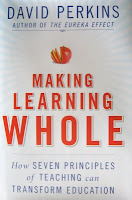
Making Learning Whole: How Seven Principles of Teaching can Transform Education. I’ve just read the first few chapters, but would like to connect his thinking to the challenges educators face in thinking about learners and learning in the 21st century.
Perkins’ “Seven Principles of Learning by Wholes”
1. Play the whole game.
2. Make the game worth playing.
3. Work on the hard parts.
4. Play out of town.
5. Uncover the hidden game.
6. Learn from the team . . . and the other teams.
7. Learn the game of learning.
The Power of a MetaphorThinking in metaphors helps us all wrestle with and understand complex concepts. As educators, we realize that learning and facilitating learning is extremely complex, so I appreciate how Perkins used the metaphor of baseball for framing his seven principles. Having only read the first chapter, which is an overview of the seven principles, I am wondering about these principles in the context of students and information literacy (a) and teachers as learners and facilitators of information literacy (b).
1. Play the whole game.
(Understand the “big picture” so you know how the smaller parts you’re working on fit—i.e. knowing about a real baseball game) a. How can we tap into the educational gaming world to access some virtual, authentic “whole games” to which students wouldn’t otherwise have access? b. Do the NETS standards frame the “whole game” of information literacy? How do we build our familiarity of this “whole game”? (i.e. Just because baseball exists, not all people have a clear understanding of that whole game.)2. Make the game worth playing.
(Learners are clear about why and how the learning is meaningful and connected to the real world—i.e. knowing why it might be worthwhile to learn to play baseball) a. Are we always making it clear why the information literacy game is worth playing to our students? Why do I hear teachers talk about students groaning when they’ve been assigned to “blog”? b. We’re educators functioning in very different contexts. Have we taken the time to make sure each of us, from our unique perspective, sees the worth of playing the game (i.e. blogging) in this course?3. Work on the hard parts. (Bring to light misconceptions, biases, and then reflect critically, and strategically target parts for special attention—i.e. batting practice or fielding grounders) a. Are we helping students’ identify “hard parts”(i.e. critical thinking about resources) of informational literacy or are we simply wowed by these digital natives’ apparent fluency and comfort level? b. Are teachers being supported to become aware of the “hard parts” of information literacy so that they spend time tackling that aspect of integrating technology?4. Play out of town.
(Apply understanding flexibly and wisely in novel and puzzling contexts—i.e. playing on a field where the sun hits you in the eyes and the infield is uneven.) a. How often are we gauging students’ performances in such varied and novel contexts? b. How might we have more opportunities to hone our information literacy skills and understanding repeatedly and in novel contexts?5. Uncover the hidden game. (Deep learning involves layers, underlying principles and concepts that need to be addressed—i.e. statistical and strategic aspects of a baseball game) a. Are we aware enough of the hidden game of the connected 21st century to help our students discover it rather than just be skating on the surface? b. To what extent and in what ways are we uncovering the hidden game of this connected world or of information literacy in this course?6
. Learn from the team . . . and the other teams.
(Social constructivism—we learn a great deal from being on a baseball team and from how other teams behave and interact.) a. To what extent are the digital natives more deeply and intrinsically collective, and socially constructing deep understanding than the non-natives? b. To what extent are we socially constructing our understanding to a deeper level or more effectively than if this were learning in a wholly f2f course?7. Learn the game of learning.
(Being metacognitive so we can become more effective and efficient in the game of learning—i.e. how my learning in baseball can improve my efficiency in learning other games) a. In what ways are we supporting students’ metacognition about how they’re learning as digital natives so they can more effectively and efficiently learn in non-digital situations? b. As experienced learners, to what extent and in what ways are we applying what we know about how we best learn to our learning in this course?So far in this great read there is nothing new regarding learning theories, but Perkins has created a metaphorical framework solidly grounded in these theories to address what we so often suffer from in education:
elementitis (tackling elements in the absence of a whole) and
aboutitis (learning about something rather than learning to do something—i.e. reading about science rather than doing it.) I’m looking forward to digging into each of the seven principles and thinking about them in relation to information literacy.

 http://www.flickr.com/photos/rosswebsdale/2442167618/


